The important of earned value management

Often there is discussion on why the EV needs to be matured and what are its benefits – tangible and as well as non tangible. I am making a small attempt to list some its benefits and keen to know your thoughts – 

The benefits of improved EVM at enterprise or PMO level:

– Standardised processes for managing project performance on a programme
– Improves transparency and strategic reporting senior management through
dashboards
– Improved timeliness and quality of reports through streamlined reporting
– Improved standardisation and automation of reports resulting in reduced
costs for report production and improved employee job satisfaction for
project controls teams members
– Employee development of competencies
– Produces historical data that can be used for lessons learned and to
improve future estimating
– Produces man-hour utilisation and productivity statistics for HR
planning
– Improved compliance with corporate financial reporting requirements
– Provides valuable strategic and operational information for improved
decision making (high tangibility)
– Reduced costs and increased benefits through improved project and
program decision making (low tangibility)
– Reduced reporting cycle times
– Improved communication and standardised processes for project
estimating, planning, scheduling, cost control, contracts administration
and project accountants.

The benefits of improved EVM maturity at project level:

– Continuous feedback on project work progress and productivity
– Early identification of performance trends and root causes
– Improves transparency and reduces the risk of disputes between owner and
contractor
– Improves project forecasting, planning of key resources
– Produces historical data that can be used for lessons learned and to
improve future estimating
– Produces quantity statistics, man-hour statistics and other data that
can be used by other functions such as safety

Thanks for reading. 

Anil Godhawale
Managing Director, Projcon Group

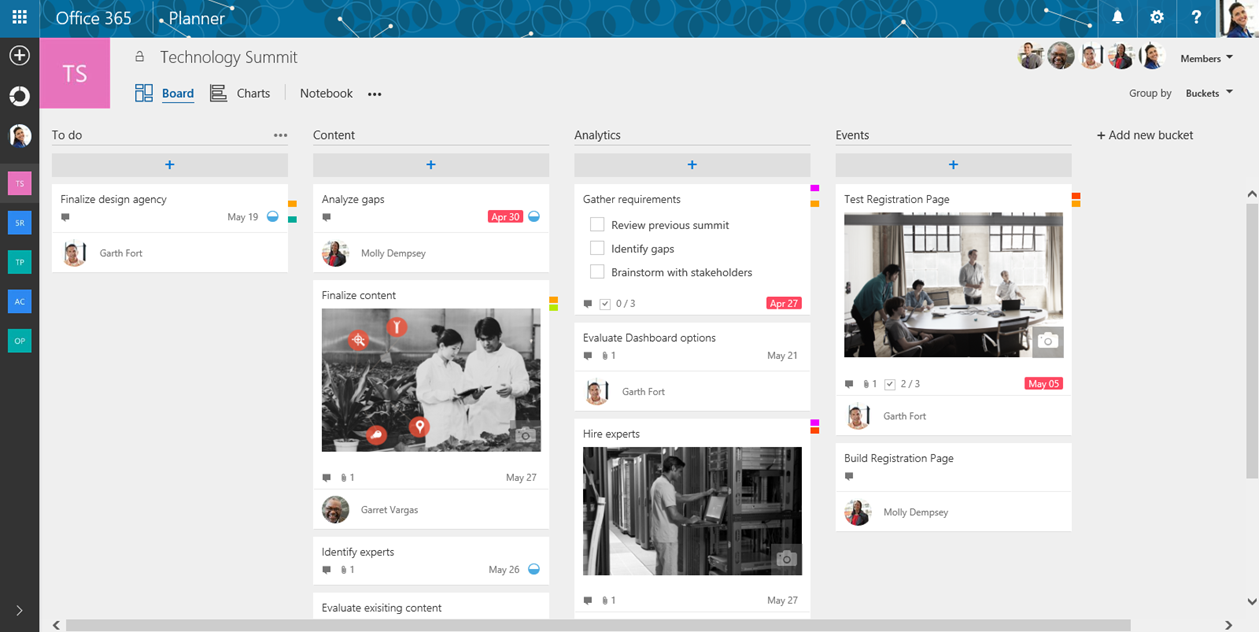
Apa itu Microsoft Planner.

Awal juni 2016 ini, microsoft telah meluncurkan project management app,  product ini diberi title : microsoft Planner, bila anda pernah menggunakan trello, persis semacam itu.
Planner diluncurkan utk mengejar posisi microsoft utk pasar ini, seperti diketahui, pasar ini cukup menjanjikan, dipasar ada puluhan product yg saling bersaing, cloud based dan banyak yg free!.
Kanbanize memberikan laju peluang kencang utk project management,  story board , dimana bisa memberikan informasi jelas status, meminimalkan work in process.  TO do list, doing,Done.

Tentu kelebihan planner tdk utk menyaingi microsoft project  karena ceruk pasar yg berbeda.

Integrasi ke product microsoft lain seperti office365 , outlook, note, skype for business akan jd senjata berat utk pesaingnya. Dilaporkan satu pemerintah daerah di portugal langsung tertarik utk memakainya.

Seperti apa penampilannya ;

What is ITIL?


What is ITIL?
• Systematic approach to high quality IT service delivery
• Documented best practice for IT Service Management
• Developed in 1980s by what is now The Office of Government Commerce


The Case for IT IL
• The Business is more and more dependent on IT.
• Complexity of IT
• Global competitiveness
• Flexible approach to integration.
• Cost controlling of IT.
• Low customer satisfaction levels.


Benefits to the Organization

• Improve Resource Utilization
• Be more competitive
• Decrease rework
• Eliminate redundant work
• Improve upon project deliverables and time
• Improve availability, reliability and security of mission critical IT services
• Justify the cost of service quality
• Provide services that meet business, customer, and user demands
• Integrate central processes
• Provide demonstrable performance indicators (kpi)


How to
• Create a sense of urgency!
• Service Management Strategy
• Engage all employees
• Communications and Awareness campaigns
• Focus on CTQ


What NOT to do
1. Insufficient Management Budget.
2. Ignoring the need to market and communicate within & outside IT.
3. Thinking that technology alone can address the requirement for ITIL i.e. migrating bad process to new technology so automation is therefore not efficient enough to address IT needs.
4. Not dedicating enough resources to the development effort.
5. Thinking process development equates to process implementation.
6. Weak documentation effort leads to inconsistent approach with very little chance of repeatability amongst IT Staff.


Why Implement ITIL
• Reduce Cost of Operations
• Improve Service Quality
• Improve User Satisfaction
• Improve Compliance


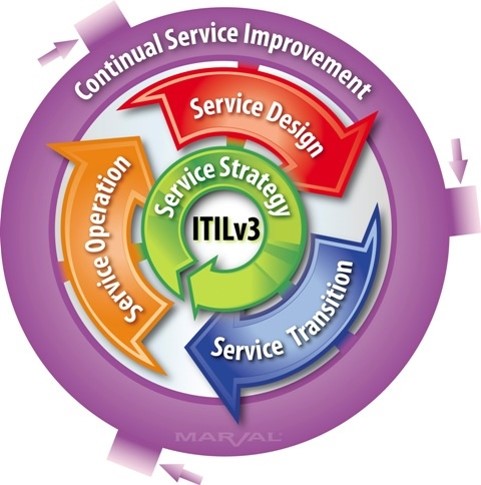
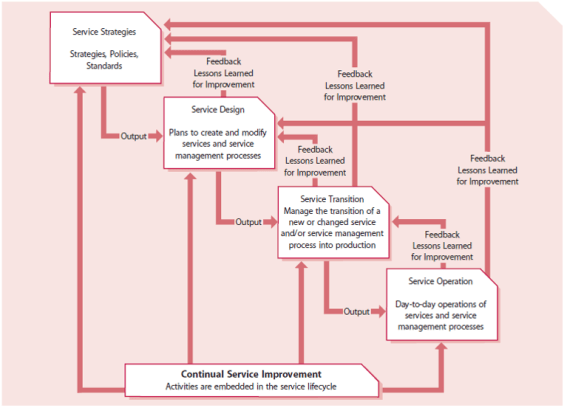
iterative process

ITIL v3, Core Book Titles:

  • Service Strategies
  • Service Design
  • Service Transition
  • Service Operations
  • Continual Service Improvement

itilv3

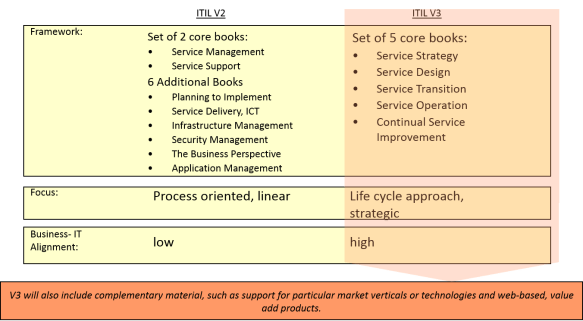
V2 vs. V3 Overall Changes

Service Strategy
• Aligns business and IT so that each brings out the best in the other,

itilv3 a
Concept:
 Value creation
 Service Provider types
 Service assets
 Service capabilities & resources
 Service structure
 Defining The service market
 Developing service offering
 Demand management
 Financial management
 Service portfolio
 Service assessment
 Return on investment


Service Design
• The design of new or changed service for
introduction into the live environment
Concept:
Aspect of service design
Service Catalogue Management
Service requirement
Service design model
Capacity Management
Availability Management
Service Level Management


Service Transition
• ALIGN THE NEW CHANGED SERVICES WITH
THE CUSTOMER’S BUSINESS REQUIREMENTS
& BUSINESS OPERATION
Concept:
TRANSITION PLANNING
ASSET & CONFG MNGMT
RELEASE & DEPLOYMENT MNGMT
CHANGE MNGMT
TESTING & VALIDATION


Service Operations
• Day to day operation of services & service
management Processes
Concept:
Incident Management
Problem Management
Event Management
Request Fulfillment
Access Management


Continual Service Improvement

7 Steps Improvement
• Review, analyze & make recommendation on
improvement in each lifecycle phase. (PDCA)
Concept:
Business and technology drivers for improvement
Improvement
Benefits
ROI
VOI


Real World Benefits
> Procter & Gamble
Started using ITIL in 1999 and has realized a 6% to 8% cut in operating costs. Another
ITIL project has reduced help desk calls by 10%. In four years, the company reported
overall savings of about $500 million.
> Caterpillar
Embarked on a series of ITIL projects in 2000. After applying ITIL principles, the rate of
achieving the target response time for incident management on Web-related services
jumped from 60% to more than 90%.
> Nationwide Insurance
Implementing key ITIL processes in 2001 led to a 40% reduction of its systems outages.
The company estimates a $4.3 million ROI over the next three years.
> Capital One
An ITIL program that began in 2001 resulted in a 30% reduction in systems crashes and
software-distribution errors, and a 92% reduction in “business-critical” incidents by 2003.

Basic Steps for Project Management Improvement


  1. Assess current Process (Where are we now?)
  2. Determine process goals (Where do we want to be?- measurable targets)
  3. Prioritize process improvement needs. (How do we get there?)
  4. Select process for improvement
  5. Identify improvement initiatives
  6. Launch improvement projects
  7. Compare results against goals. (How do we check we got there? – Measurements & Metrics)
  8. Continuously Improvement

What IS Oracle’s Application Implementation Method (AIM)?

What Is AIM?


  • Oracle’s Application Implementation Method (AIM) is a proven approach for implementing Oracle Applications.
    • –      Support for All Oracle Application Product Families
    • –      Support for All Aspects of the Project (Project life cycle)
    • –      Focus on Meeting Requirements and Return On Investment Goals
    • –      Scalable to Meet Specific Project Requirements
    • –      Designed For Quicker Implementations
  • AIM projects are conducted in phases.
    • Definition
    • Operation analysis
    • Solution
    • Build
    • Transition
    • Production
  • These phases provide quality and control checkpoints to coordinate project activities that have a common goal.
  • During a project phase, your project team will simultaneously be executing tasks from several processes.

Definition:

  • During Definition, you plan the project, review the organization’s business objectives, understand the business processes, and evaluate the feasibility of meeting those objectives under time, resource, and budget constraints.
  • The emphasis is on building an achievable workplan and introducing guidelines on how the organization will work to achieve common objectives.
  •  Establishing scope early in the implementation gives the team a common reference point and an effective way to communicate. Strategies, objectives, and approaches are determined for each AIM process, providing the basis for the project plan.In addition, the Communication Campaign for the project is begun

Operations Analysis:

  • During Operations Analysis, the project team develops the Business Requirements Scenarios based on deliverables from Definition that are used to assess the level of fit between the detailed business requirements and standard application functionality.
  • Gaps are identified and new proposed solutions are developed.
  • The analysis results in a proposal for conducting business operations under the envisioned application technical architecture.
  • Proposed solutions for gaps evolve into detailed designs during the Solution Design phase

Solution Design

  • The purpose of Solution Design is to develop the detailed designs for the new system to meet the future business requirements.
  • During this phase, project team members create detailed Business Procedure Documentation

Build

  • The coding and testing of all customizations and other custom software, including application extensions, data conversions, and interfaces, is done during the Build phase.
  • Business system testing is performed to validate that the functionality meets business requirements.
  • Finally, during Build the production support infrastructure is designed and a Transition and Contingency Plan is developed

Transition

  • During Transition, the project team deploys the new system into the organization.
  • All the elements of the implementation must come together to transition successfully to actual production.
  • The project team trains the users while the technical team configures the Production Environment and converts data.

Production

  • Production begins immediately with the production cutover.
  • It marks the last phase of the implementation and the beginning of the system support cycle.
  • A series of refinements and performance measurement steps is included in this final phase.
  •  The information technology personnel work quickly to stabilize the new system and begin regular maintenance. They provide the ongoing support to the organization for the remaining life of the system.
  • During Production, you compare actual results to project objectives and determine if improvements can be made.
  • Controlled system refinement begins to minimize the impact to users.
  • Finally, you start preliminary planning of the future business and technical direction of the company.