Deretan Project management software gratis menarik menunjang business anda.

​Project management information system , PMIS adalah hal tak terpisah dari organisasi, Enterprise mandatory factor.

Tak ada alasan mahal , tak ada alasan perusahaan masih kecil, belum perlu dll , yg penting ada kemauan , anda bisa jadikan business anda lebih profitable, berikan kesan professional ke pelanggan anda.

Project management adalah hal tak terpisah dari business anda, jadikan margin lbh bergerak kearah lbh baik.

Rekomendasi dibawah Redmine.
source: opensource.com

Top 11 project management tools for 2016

robinmuilwijk


For the last three years, I have rounded up the most popular open source project management tools for Opensource.com readers. As there continues to be major reader interest in this area, I decided to take a look back at the tools we covered in 2014 and 2015, and give you updates on all of these projects. I looked to see which projects had new releases, notable new and improved features, and more.

Let’s take a look at each of these projects and try to answer some of the questions readers have had in the comments of last year’s edition, including which are still in active development, provide hosting options, offer a mobile solution, and more.

MyCollab
pm16-mycollab.png

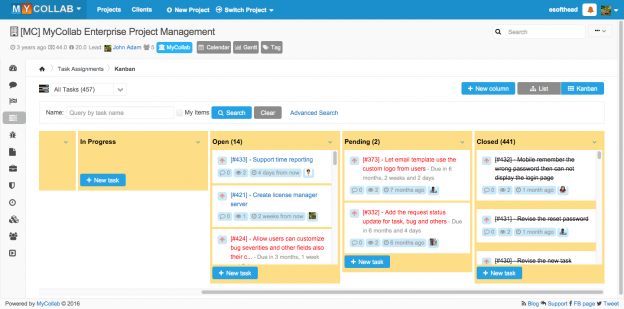
MyCollab is a multi-purpose solution which features tools for customer relationship management, document management, and project management. In this case, let’s look at MyCollab-Project.

MyCollab-Project includes many features, like a Gantt chart and milestones, time tracking, and issue management. It also supports agile development models with its Kanban board. MyCollab-Project comes in three editions, of which the community edition is the free and open source option.

The current MyCollab version is 5.2.9 released on March 14, 2016. With a previous release, 5.2.6, mobile readiness has been greatly improved.

MyCollab is licensed under AGPLv3, requires a Java runtime and MySQL stack, and the source code is available on GitHub.

Odoo
pm16-odoo.png

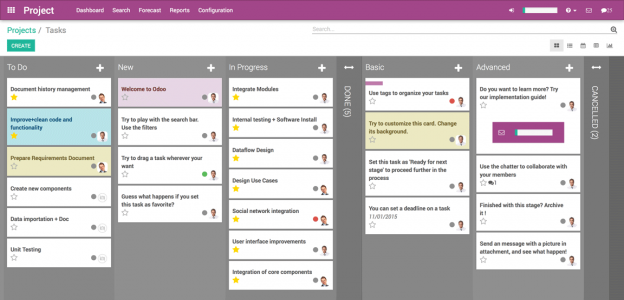
Odoo is a full suite of business applications, of which project management is just one. Odoo is a multiplatform solution, supporting Windows, several Linux distributions, and other operating systems as well.

The community edition is, of course, free and open source, but limited in features compared to the enterprise version. Odoo project management has some interesting features, such as Gantt charts, a Kanban view, tasks and issues, graphs, and more. Notable assets are the community resources, and its official Docker image.

Odoo is licensed under GPLv3, and requires Python and PostgreSQL. Its latest release, 9.0, is available for download and as source onGitHub.

Taiga
pm16-taiga.png

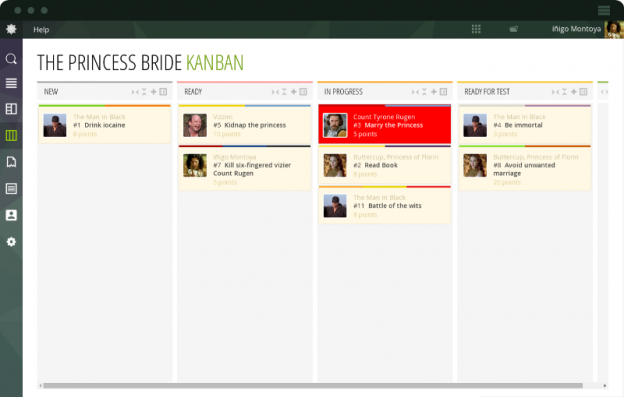
Taiga is an open source project management platform for startups, agile developers, and designers. It focuses on agile development methods, and has all of the required features such as a backlog, Kanban board, tasks, sprints, and issues.

Notable pros are the integration with GitHub, GitLab, and Bitbucket, making it an interesting project management tool for developers. Taiga can also be extended through plugins, and has a REST API.

Taiga is licensed under GNU Affero GPLv3, and requires a stack which includes Nginx, Python and PostgreSQL. The latest release, 1.10.0 Dryas Octopetala, is available on GitHub.

OrangeScrum
pm16-orangescrum.png

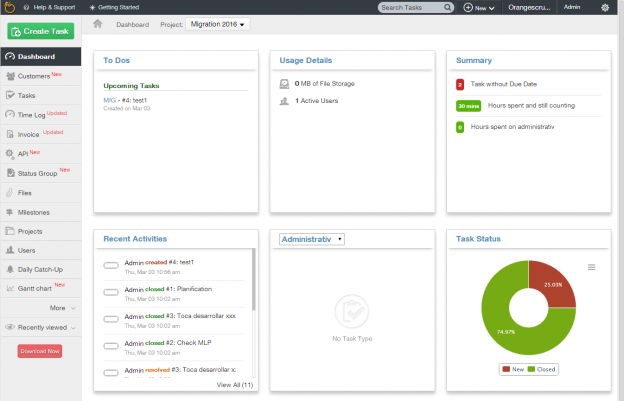
OrangeScrum is a project management tool for freelancers, agencies, and small to medium businesses. It includes features such as a scrum task board, resource planning, progress tracking, Kanban and Gantt chart views.

Notable for OrangeScrum are its new skin, based on the Google Material Design. Android and iOS mobile appications are expected for version 2.0, in June 2016.

OrangeScrum is licensed under GPLv3, and is based on the CakePHP framework. Its latest release 1.5.9. is available for download, and the source code can be found on GitHub.

Tuleap Open ALM
pm16-tuleap.png

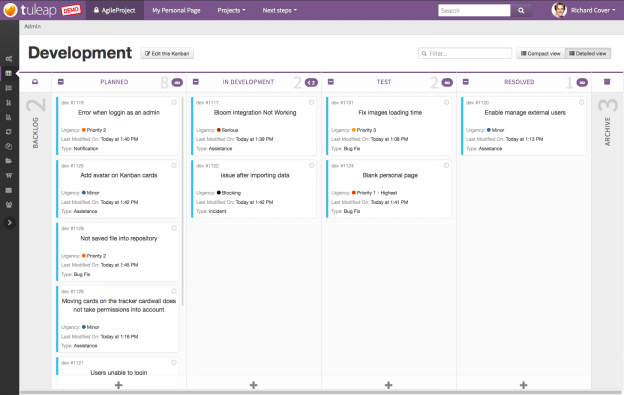
With a focus on software development projects, Tuleap provides a feature richplatform which includes project management features like Scrum and Kanban support, tracking, document management, and other collaborative tools.

Pros for Tuleap are support for agile, traditional, hybrid, or custom processes for project management. It supports planning, sprints, tasks, reports, and more. This tool is very suitable for open source development companies, as the tool also integrates with Git, SVN, Jenkins, and more. Tuleap also provides an appliance installation (virtual machine), or installation through Ansible.

Tuleap is licensed under GPLv2. Its latest release Tuleap 8.12 can be downloaded from the site.

Agilefant
pm16-agilefant.png

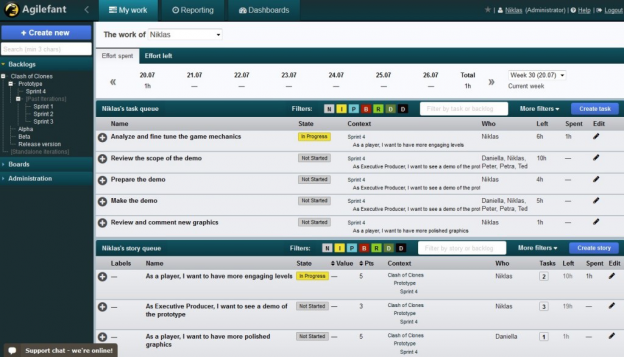
Agilefant has focuses on agile approaches involving Kanban and Scrum, but also can be bent to support traditional approaches to project management such as the waterfall method.

Agilefant offers a free and open source product that can be downloaded and deployed into your own private cloud. Called a solo plan, you can also sign up for a free cloud offering.

Agilefant runs on Java, Tomcat, and MySQL. The source code and license can be found onGitHub.

Redmine
pm16-redmine.png

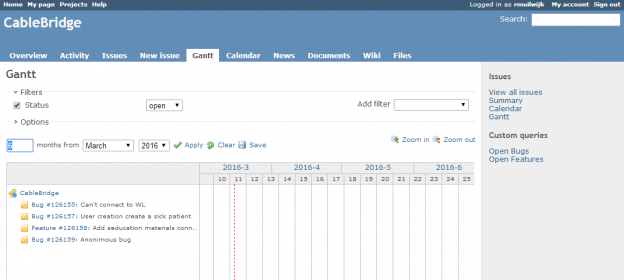
Redmine is a web-based project management tool. Where it lacks some of the enterprise features, it makes up for that with strong features such as a wiki, repository, and issue tracker.

Redmine also has an advantage in access: it is available to project managers, other team members, as well as, the clients.

Redmine is licensed under GPLv2, and requires Ruby and Rails and a database platform like MySQL, PostgreSQL or SQLite. Its latest release 3.2.1 is available as a download.

]project-open[
pm16-projectopen.png

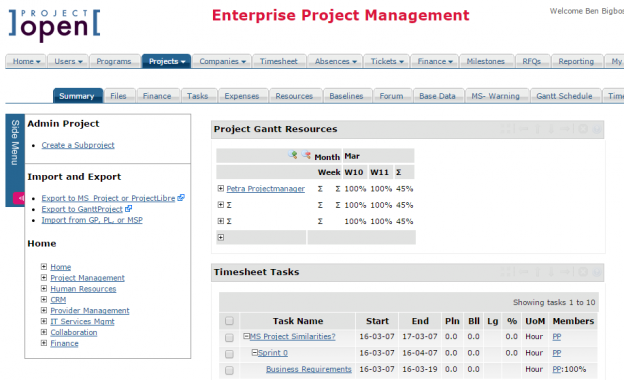
]project-open[ is an enterprise project management tool with many features, including support for agile methods. The software is released under a mixed source model, or a “dual license,” meaning that at its core it is open source (GPL), with additional modules released under a commercial license. ]project-open[ runs as client software on both Windows and Linux, depending on a stack of open source packages.

]po[ is currently working on version 5.0, which includes a Gantt editor, a portfolio Pplanner and several charts rendered in HTML5.

]po[ is available in many forms, as installers for both Linux and Windows, but also in cloud images, and as virtual appliance.

OpenProject
pm16-openproject.png

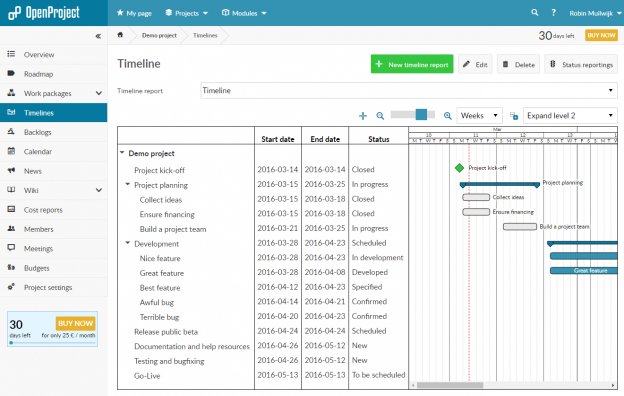
With its feature set, OpenProject is designed to support your project teams throughout the whole project lifecycle and offers collaborative project planning, timeline reports, task management, time and cost reporting, Scrum, and much more. Some aspects of OpenProject, which makes this tool stand out, are its user interface, extensive documentation, API, and rich feature set, which makes it a good choice for enterprise needs.

OpenProject is currently working on version 5.1, which will bring inline work package creation, design and usability improvements, accessibility improvements, and more.

OpenProject is licensed under GPLv3. Its current version 5.0.16 is available for download.

LibrePlan
pm16-libreplan.png

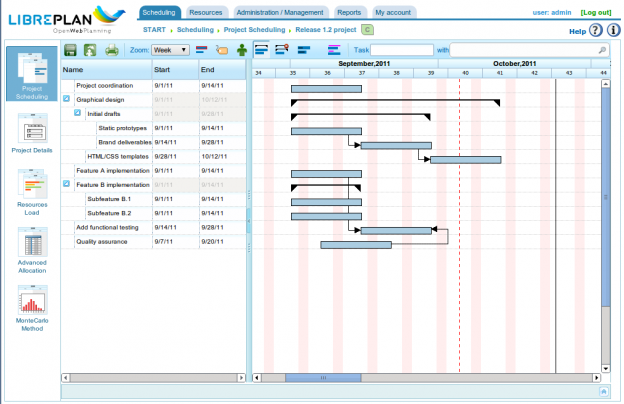
LibrePlan is a web-based application, making project management available to not just the project manager, but the entire project team, and if necessary across organizations. This is another full featured tool supporting resource allocation, Gantt charts, financials, and more. These features coupled with a web based application make LibrePlan a great collaboration platform.

LibrePlan provides a modern design and balanced user interface, as well as, good and complete documentation, built in reporting, and professional support. A mobile application is available for Android, Windows phone, and other platforms.

LibrePlan is licensed under GPLv3. It requires components a Java runtime environment, PostgreSQL, and Tomcat. Its available for download, and the source code can be found on GitHub.

ProjectLibre
pm16-projectlibre.png

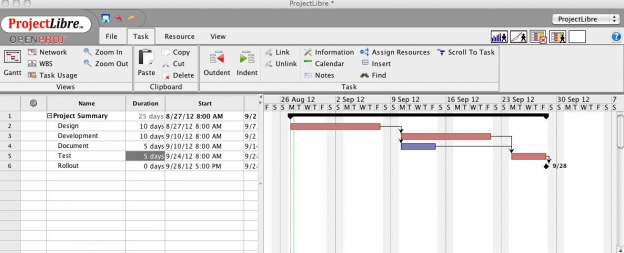
ProjectLibre is an award winning tool, which has been downloaded over two million times in 200 countries. It holds features such as support for task management, resource allocation, tracking, Gantt charts, and much more.

The ProjectLibre team is completely rewriting the code, giving it a new modular architecture, which in turn allows for a more robust engine.

ProjectLibre is licensed under a Common Public Attribution License Version 1.0. It’s based on Java, and available for download.


This is by no means an exhaustive list. Are you using a tool we did not cover that you think should have been mentioned? Leave a comment below. Or, feel free to share your experience with one of the tools we did cover.

Creative Commons License

Apa itu Mind map, caranya bagaimana, mengapa berguna  dan penting , What Are Mind Maps?

Bila ada yg masih blm mengenal, mind map adalah cara mengilustrasikan cara berpikir kita tanpa batas, artinya setiap hub antara satu ide dgn ide lainnya bisa kita tunjukkan, cara ini bisa menunjukkan utk problem definition, case studies, idea problem case breakdown, 

Dan menariknya software ini gratis , google it yourself, 

Anda bisa membantu menterjemahkan semua idea dr team anda dan apa saja yg berhubungan , anda tdk perlu menjadi mahir, keluarkan semua hal , berikan relationship yg berhubungan, anda akan terkejut, betapa hal sederhana ternyata ada byk hal yg terkait, utk executive management andapun bisa tampilkan dlm high level , helicopter view.


Apapun yg ingin anda sampaikan tdk hy dlm mind map, ingat harus ada structure, frame work, sehingga orng lain paham arah tujuan anda.

Legend has it that in the summer of 1994, as the production of Toy Storywas wrapping up, four Pixar creativeswent to lunch to brainstorm ideas for new projects. Sketching on napkins, they teased out ideas for what would become Wall-E; Monsters, Inc.; A Bug’s Life; and Finding Nemo.

It’s inspiring that such massively successful blockbusters started on napkins, but that’s the first step for any good idea, right? Getting ideas out of your head and putting it into the world in some tangible way is how you turn them into reality.

Most people don’t sketch the next great animated movie characters on napkins, but we all need a way to tease out our ideas, think through concepts, and put them into a usable format. That’s essential for creativity, in our personal lives and in business. Lists, outlines, and notes can help, but they don’t always lend themselves to radical innovation, learning, or problem-solving.

There’s a better way: mind maps.

What Are Mind Maps?

Mind Maps

Mind maps can help you capture and stimulate ideas, as well as serve as an important reference

Mind maps are a visual way to organize your thoughts around one topic using words, colors, images and numbers to highlight ideas and draw connections. Invented by Tony Buzanin the 1960s, mind mapping is much more than drawing: It’s a framework to help you fully think through ideas, and show how topics and ideas are connected and allowing with more flexibility than an outline or list affords.

Mind mapping can be a solo or team activity, and they can be used for all types of tasks: learning, thinking through ideas, strategic planning, mapping out processes or organizing overwhelming amounts of information. I’ve even come across mind maps made to plan weddings or organize Thanksgiving dinner.

Roy Grubb, Managing Director atG&A Management Consultants Ltdand creator of the Visual Thinking Center, told me mind maps are of two types: “Maps where the benefit is mainly in the process of making the map, the thinking process, the memory jogging, the stimulation of new ideas and associations; and maps where the benefit is the map as a reference and communication point.”

Why Use Mind Maps Instead of Lists or Outlines?

Mind Map example

Mind maps’ free format encourage fresh ideas

You don’t have to make a mind map—you could just jot a note down on that napkin, or use an outlining app to list the things you’re thinking about. So why mind maps?

“Lists always get long, and they assign importance in terms of where the item is on the list,” explained MeisterLabs co-founder Michael Hollauf. “If something is further down, it’s inherently less important. If you have topics that are on a similar level, it’s hard to show that in a list. Mind maps can reorganize really easily if you decide something belongs to something else.”

In other words, instead of capturing information linearly by default, mind maps can show–and help you discover–connections between different topics, the way your mind works.

List or outlines can be great for small tasks, but Grubb told me fresh ideas are more likely to pop up when creating a mind map because of the free format. “When I’m planning a project, a mind map helps me capture my ideas without having to lay out steps in a linear fashion. I find that a linear list, or even an outline, hems me in and stops me thinking freely.”

How to make a mind map

Mind maps are pretty simple to create, and you can build them on a whiteboard, sketch them on a piece of paper, or use a mind mapping app to create them. These basic steps apply in any medium:

1. Start in the Middle With a Central Idea

Start making a mind map

This can be a word or an image/picture that represents the central topic you’re going to map.

2. Create Branches to Represent Sub-topics

Add branches to your mind map

These should be limited to words or short phrases. Keep a good amount of space between your ideas to leave room to add on later.

3. Add Details to Your Mind Map

Add more detail to your mind map

You can vary colors, word cases, font styles, and even the thickness of your branch lines to separate or group different topics or ideas. Or, you can add photos, notes, and more to add more detail to your map.

4. Make Connections

Make connections and more in your mind map

You can draw lines or arrows between ideas in the map that you want to connect.

Keep expanding for as long as you need to. You might feel done with your map after one sitting, but it could also be something you keep and adjust or add to over time.

Other Mind Mapping Tips

If you’re a beginner

For mind mapping beginners, it can be helpful to have a pro guide your first few maps.

“Look for someone who often uses mind maps and ask their opinion,” Grubb told me. “This can help to remove blocks to mastering the technique in the early days.”

If you’re not artistically inclined

Don’t worry if you’re not an artist; that’s not the point of a mind map.

“One of the things we hear often is ‘I can’t draw,’” says Raphaela Brandner, marketing manager at MeisterLabs, creators of mind-mapping tool MindMeister. “It’s not about making it beautiful, it’s about making it memorable.”

You don’t need to make a masterpiece: “They’re thinking tools, not works of art,” Grubb says.

If you’re mapping with your team

When mapping with others, it helps to set some ground rules first. “What we do here is we come to some fort of agreement for how the map is going to be used,” Brandner says. “We say we’ll ‘add comments here’ or ‘use these icons for this.’”

With technical teams, Grubb opts for mind mapping software on a laptop with the map projected onto a screen. For teams who are new to mind maps, he maps on large sheets of paper or a whiteboard.

“It helps to be in front of the map, talking as I add to it while the ideas bounce back and forth,” he says. “I can explain what I’m doing as we go along, and at the end, capture images of the maps on a phone before erasing them.”

As the meeting progresses, Grubb gets people more involved: “I look for opportunities to hand over the marker so that everyone has ownership of the mind map.”

If you’re working remotely

Mind mapping tools make it easy for distributed teams make maps together.

“When working with others who may be in distant offices, online mind mapping services, like MindMeisteror Mindmup, are indispensable,” Grubb says. “Several people can work on a map simultaneously and they can chat online or in the app. Both MindMeister and Mindmup have project planning capabilities, allowing dates and resources to be added to individual items.”

Other mind mapping tools includeMindjetCoggleXMindFreeMindand MindNode.

When to Use Mind Maps

Mind maps are often used in schools, so people tend to associate them mainly with learning and studying. But there are a ton of business applications for mind maps, too.

“Many students are shown how to make mind maps to help with learning but never take the skill on into their business careers,” Grubb says. “Those that do find they have a tool that is good for much more than just understanding school work.”

Grubb told me he sees businesses using mind maps for ideation, product design, website design, project planning, management, report writing, and planning software testing.

Here are just a few business-focused tasks mind maps can help with:

When Absorbing What You Read

Mind Map example

Reading is an important way to grow as a professional, but with busy schedules, it can be hard to digest a book or resource enough to apply it to your work.

Mind maps can help you truly absorb what you read. For example, Grubb used a MindMap to summarize the book Made to Stick by Chip and Dan Heath. First, he read the book and highlighted words and phrases that caught his attention. When he was done reading, he went back and made a mind map from the highlighted sections and was able to use that mind map to successfully guide his next project.

Mind maps for presentations

Students turn to mind maps—especially hand-written maps—when studying because they help with memorization.

“That tactile experience works a lot better for memorizing,” Brandner says. “That’s what I did in school. Once you have mind map and you’re about to go into the exam, you redraw the mind map by hand to get it into your brain.”

You could use a similar process to prepare for a speech or presentation. You’ll feel more confident about the content and might not have to rely on notes as much during the presentation.

When Managing a Project

Mind Maps for projects

Some project managers use mind maps to take notes in meetings. Instead of pages of linear notes, you can put the meeting topic in the middle and create branches for each major sub-topic discussed.

“When I do this, it’s amazing to me how I see things differently,” writes business analyst and marketer Tim Walker. “I pay more attention during the meeting, and I leave with a much better idea of what I could do next to move the work forward.”

Making mind maps can also help prioritize project tasks.

“When you map things radially, you take away the rank order and chronology that’s inherent in an outline or Gantt chart,” Walker writes. “Instead of prematurely worrying about which part of your project comes first in sequence, or which part deserves the most resources, you can focus on getting the right issues surfaced in a way that promotes dialogue, understanding, and problem-solving”

When Trying to Generate New Ideas

Mind maps for ideas

Use mind maps to combat writer’s’ block, think up new product ideas, or generate possible solutions to a problem you’re facing.

“Generating a starting point for innovation can be one of the most productive uses of mapping,” Grubb writes. “Ideas can tumble out of control. Writing them in a list easily kills the inspiration, but organizing them in a mind map not only gives the freedom to wander ‘all over the map,’ but encourages grouping, thus often bringing ideas together that give birth to new thoughts.”

Automate Your Mind Maps

Your mind maps can be put to even more use if you connect your content in them with your favorite apps. With Zapier, an app automation tool, you can send tasks or topics from MindManager Enterprise to many other apps, such as Google Docs, Trello, Asana, and Evernote.

For example:

Send MindManager content to Google Docs

Use this Zap

Send MindManager tasks to Trello

Use this Zap

Send MindManager topics to Box

Use this Zap

Send MindManager tasks to Asana

Use this Zap

Send MindManager content to Evernote

Use this Zap

See more MindManager Enterprise integrations powered byZapier

See other MindManager Enterprise app integrations or create your own.


Who knows, maybe you are planning to pitch an idea to Pixar for Hollywood’s next loveable robot, clown fish, or furry monster. If so, ditch the napkins, and try a mind map.

And the next time you want to make sense of information, successfully plan a big project, run a meeting, learn something new, streamline the way you work or even plan Thanksgiving, mind maps can work for you, too.

Source zapier

Primavera P6 vs versus Microsoft Project

Often folks are asking about the differences between Microsoft Project and Oracle Primavera P6. While coming up with a definitive list is more than challenging, below highlights some of the detailed feature differences between Primavera P6 over Microsoft Project.

It’s All About The Enterprise

It’s clear that Primavera P6 was designed for the enterprise from the start, while Microsoft Project migrated from a desktop application and added enterprise capabilities with Project Server. Now that Oracle owns Primavera P6, this gap is accentuated with the introduction of other heavy weight Oracle applications that support Primavera P6. Examples of these include Primavera P6 Analytics, Business Intelligence Publisher, Workflow and Primavera Gateway. These tools allow for integration with other enterprise applications marrying project information with other corporate data, applications and dashboards. Microsoft has not stood still either, with additional offerings such as SharePoint and Dynamics.

With all these true enterprise capabilities in mind, below are some of the more detailed features differences listed by real users. This list is not meant to be exhaustive and only compares the desktops versions. It is also important to note that we’re not recommending one product over the other.

Multiple User Access

Microsoft Project doesn’t allow multiple users to work on a single project at the same time, Primavera P6 does. In Primavera P6 you can specify what features of Primavera a particular user is permitted to use. Microsoft Project Server supports many projects at the same time, but a user locks a project when it’s in use.

Baselines

In Microsoft Project, 11 baselines can be created for a project. In Primavera P6, unlimited baselines can be created and as many as four of these baselines can be assigned at any one time to a schedule.

Progress and Status

Primavera P6 offers a feature called Progress Spotlight. This Progress Spotlight highlights activity table rows in yellow if they are due any status in the next period (day, week, month, quarter or year). Microsoft Project requires the development of filters to allow for the selection of activities requiring status.

Issues & Risk

Microsoft Project lacks a feature for tracking project issues or risks. Primavera P6 can record issues and risks against a project, WBS element or activity.

Web Support

Primavera P6 plans, documents and other information can be converted to HTML directly from the software. Microsoft Project doesn’t have such options.

Steps

The Steps feature in Primavera P6 allows you to create sub-activities (steps) of an activity; effectively a to-do list for discrete progressing. Each step has a weighting that can be used to drive % complete for an activity as the steps are marked off as completed. The additional P6 Step Template allow this feature to be used for common processes that appear often among projects. This capability is not available in Microsoft Project.

Expenses

In addition to resource costs, Primavera P6 allows planned, remaining and actual project expenses (training, travel, ODC) to be entered at the activity level.  Microsoft Project doesn’t have this capability.

Custom Fields

Both Microsoft Project and Primavera P6 allow you to create custom fields. Microsoft Project also allows you to define formula for custom fields and add additional values to it. In Primavera P6 you can create a blank custom field, but you cannot set formulas to it, so users have to manually enter values in each field, for each column. You can use Activity Codes in P6 to create a column that has values that can be picked from a list similar to the Lookup feature in Microsoft Project’s custom fields.

Multiple Activity Relationships

In Primavera P6, more than one type of relationship can be established between activities, e.g. we can have FF and SS between the same two activities. In Microsoft Project only one relationship can be made between two activities.

External Relationships

In Primavera P6, multiple projects can be opened at one time for editing. This allows for relationships to be established between activities in different projects when inter-dependencies exist using identical techniques to assign the relationships. Microsoft Project uses a special feature called Links Between Projects to achieve inter-project dependency modeling.

Project Website

Primavera P6 can create a comprehensive website comprising of all the project details including activities, resources, reports, risks, issues, WBS, and anything else that a user can define. This website feature is not present in Microsoft Project without using Project Server.

Multiple Project Creation and Tracking

Both Microsoft Project and Primavera P6 allow for multiple projects to be created and viewed. However, Primavera P6 capabilities extend beyond this to include multiple project tracking, multiple project or WBS comparisons, cost and units calculations.

Discussions

Primavera P6 has the ability to have threaded discussions with other team members from within the tool.

Hint Help

To help new and experienced users alike, P6 Professional offers a Hint Help toggle feature that explains the values and calculations for a column when the cursor is placed on the field. No equivalent feature exists in Microsoft Project.

Summary

There are many more minor differences between Primavera P6 and Microsoft Project but above list attempts to highlight seem of the more commonly referred differences between the two tools. We are well aware of folks that favor one system over the other and I’m sure this list will spark much conversation, debate and disagreement.

Using this list to support a decision to buy one product over the other would not be a wise idea. Also, these comparisons are only between the desktop versions.

Choosing an enterprise project management system should be based on your organizational requirements which would be at a much higher level than a few detailed features listed here. Finally, enterprise deployments often involve integration and information sharing with other corporate applications, must run on a particular IT infrastructure and support existing processes. All of these requirements can have an effect on your decision which way to go.

Download many good articles Primavera project management P6, ms project to primavera etc.

Primavera P6 Downloads

February 12, 2015 By 


We’ve posted over the past few years some really handy eBooks, guides, desktop aides, tips and step-by-step instructions related to Primavera P6. Here we’ve consolidated some of the most popular downloads and requested materials that we’ve received over time. So, whether you’re a seasoned veteran user of Primavera P6 or new to the tool, there is something here for everyone.

Feel free to download any of the Primavera P6 materials that you might find useful and if you share this with colleagues and friends, let them know where you go them from. So let’s get started with our ever popular step-by-step installation guides.


Primavera P6 Installation Guides

Windows 7 – Primavera P6 Professional R8.4 Installation Guide

Windows 8 – Primavera P6 Professional R8.4 Installation Guide

Windows 10 – Primavera P6 Professional R15.2 Installation Guide

Installing Primavera P6 using SQL Server

Primavera P6 Tested Configurations Archive


Primavera P6 EPPM

Primavera P6 EPPM Hot Keys

Primavera P6 EPPM – Understanding Date Columns

Understanding Dashboards in P6

Primavera P6 Reports Tab Samples

Primavera P6 Portlets Index

Global and Project Security Profile Settings in Primavera P6


Primavera P6 Professional

Primavera P6 Professional – Understanding Date Columns

Primavera P6 Professional Hot Keys

Primavera P6 Toolbar Map


Project and Earned Value Management

WBS Guidelines for Government Acquisition Programs

Ten Six Project Management Crossword

Ten Six Earned Value Management Crossword


Microsoft Project to Primavera P6 Conversion Guidelines

Microsoft Project to Primavera P6 Conversion Guidelines


Legacy Primavera

Primavera P3 to Primavera P6 Conversion Guidelines

We hope you find these useful. Please send us your comments and let us know what you think.

What’s new in Microsoft Project 2016

We are excited to announce availability of Project 2016. This release includes significant updates to Project Professional, Project Pro for Office 365 and Project Online. Project 2016 delivers on some of the most requested capabilities: Resource Management and Resource Capacity Planning. Supporting these key capabilities are enhancements such as new Resource Engagements, a brand new experience for resource managers, and Capacity heat maps. Project 2016 now provides an end-to-end experience for managing and optimizing your resource utilization.

In addition to resource management, there are a host of improvements and new features to help you be more productive with Project, such as improved timelines, Tell Me integration and full support for Office add-ins.

Resource Engagements

For project managers, securing resources to ensure your project is properly staffed has always been a challenge. With Project 2016, it’s now possible to systematically request a resource, and once approved, lock that resource to guarantee it’s available.

Creating an engagement and submitting it for approval sets off a simple workflow that enables the resource manager to approve or reject the request.

The project manager will always have an up-to-date view of the status of their requests from within Project Professional 2016 or Project Pro for Office 365. Once a locked resource is assigned to a project for a duration of time, managers of other projects will get notified if they try to overbook a resource.

The resource manager experience

The resource manager (or line manager) is a people manager who may not want to use the full Project client. To allow the resource manager to collaborate with the project manager, Project Online now has an area for the resource manager to view and approve or reject all proposed resource contracts. In addition, the new resource views allow the manager to understand the capacity utilization of their resources at a quick glance.

Resource Capacity heat maps

Ensuring that the resources are well utilized and productive is a key strategic need for any company. Project 2016 introduces the Capacity heat maps and a brand new set of intuitive reports to enable at-a-glance visualization of resource utilization. Both under- and over-utilization of resources can be problematic, and both can be seen quickly with the new heat map.

Timelines

Communicating the project schedule is a critical part of any project manager’s job. But for many audiences, a Gantt chart isn’t the best way to visualize the schedule. More than ever, a timeline is the best way to communicate how a project’s lifecycle lays out. With this in mind, we have overhauled the Timeline feature to include multiple timelines, each with different start and end dates, representing a user-defined set of tasks and milestones.

There are several rich features in the new Timeline visualization, including:

  • Independent start and end dates for each timeline.
  • Drag and drop between different timelines.
  • Save to PowerPoint with editable objects.

Tell Me

With so many features in Project 2016, wouldn’t it be great if you could just ask where a certain feature was, instead of having to hunt for it? With Tell Me, you can do just that. Better yet, the answer that Tell Me provides is a live button, so you just have to click the answer and it will do as you ask. It’s a huge time saver.

new in Project 2016 6

Read/Write Office add-ins

Office add-ins are extensions that you can download from the Office store that add functionality to Project. This means that Microsoft and its partners can continuously and easily deliver new features so you can customize Project to your tastes. With Project 2016 release, Office add-ins now have full Read/Write access to the project you are working on, providing richer extensions than have ever been possible.

new in Project 2016 7

Availability

Project 2016 is immediately available online as part of Office 365. The new service side features, such as Capacity heat maps, are being rolled out intoProject Pro for Office 365 andProject Online right now. When you choose to activate these features, we will automatically upgrade all of your existing Resource Plans to Engagements. The new resource management features will be available to on-premises customers in the spring of 2016 when Project Server 2016 is released.

Enjoy the new Project!

—Howard Crow, principal group program manager in the Project engineering team