WHAT IS Work Breakdown Structure (WBS)

Source workbreakdownstructure.com.


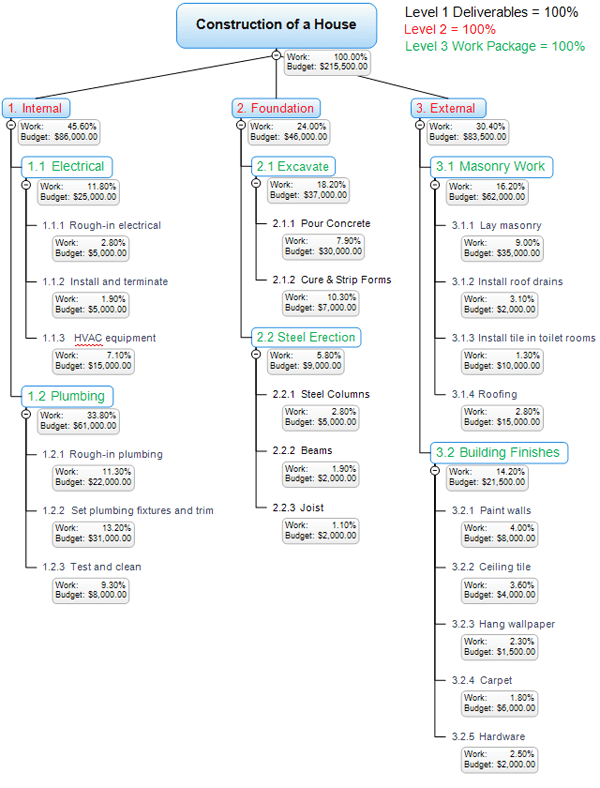
work breakdown structure is a key project deliverable that organizes the team’s work into manageable sections. The Project Management Body of Knowledge (PMBOK) defines the work breakdown structure as a “deliverable oriented hierarchical decomposition of the work to be executed by the project team.” The work breakdown structure visually defines the scope into manageable chunks that a project team can understand, as each level of the work breakdown structure provides further definition and detail. Figure 1(below) depicts a sample work breakdown structure with three levels defined.

Work Breakdown Structure (WBS)

Work Breakdown Structure for Construction of a House
Figure 1. Work Breakdown Structure
Click Here for full size image

An easy way to think about a work breakdown structure is as an outline or map of the specific project. A work breakdown structure starts with the project as the top level deliverable and is further decomposed into sub-deliverables using the following outline hierarchy (Figure 2):

Work Breakdown Structure Deliverable
Figure 2. Work Breakdown Structure Deliverable

The project team creates the project work breakdown structure by identifying the major functional deliverables and subdividing those deliverables into smaller systems and sub-deliverables. These sub-deliverables are further decomposed until a single person can be assigned. At this level, the specific work packages required to produce the sub- deliverable are identified and grouped together. The work package represents the list of tasks or “to-dos” to produce the specific unit of work. If you’ve seen detailed project schedules, then you’ll recognize the tasks under the work package as the “stuff” people need to complete by a specific time and within a specific level of effort.

From a cost perspective, these work packages are usually grouped and assigned to a specific department to produce the work. These departments, or cost accounts, are defined in an organizational breakdown structure and are allocated a budget to produce the specific deliverables. By integrating the cost accounts from the organizational breakdown structure and the project’s work breakdown structure, the entire organization can track financial progress in addition to project performance.

Why use a Work Breakdown Structure?

The work breakdown structure has a number of benefits in addition to defining and organizing the project work. A project budget can be allocated to the top levels of the work breakdown structure, and department budgets can be quickly calculated based on the each project’s work breakdown structure. By allocating time and cost estimates to specific sections of the work breakdown structure, a project schedule and budget can be quickly developed. As the project executes, specific sections of the work breakdown structure can be tracked to identify project cost performance and identify issues and problem areas in the project organization. For more information about Time allocation, see the100% Rule.

Project work breakdown structures can also be used to identify potential risks in a given project. If a work breakdown structure has a branch that is not well defined then it represents a scope definition risk. These risks should be tracked in a project log and reviewed as the project executes. By integrating the work breakdown structure with an organizational breakdown structure, the project manager can also identify communication points and formulate a communication plan across the project organization.

When a project is falling behind, referring the work breakdown structure will quickly identify the major deliverables impacted by a failing work package or late sub- deliverable. The work breakdown structure can also be color coded to represent sub- deliverable status. Assigning colors of red for late, yellow for at risk, green for on-target, and blue for completed deliverables is an effective way to produce a heat-map of project progress and draw management’s attention to key areas of the work breakdown structure.

Work Breakdown Structure Guidelines

The following guidelines should be considered when creating a work breakdown structure:

  • The top level represents the final deliverable or project
  • Sub-deliverables contain work packages that are assigned to a organization’s department or unit
  • All elements of the work breakdown structure don’t need to be defined to the same level
  • The work package defines the work, duration, and costs for the tasks required to produce the sub-deliverable
  • Work packages should not exceed 10 days of duration
  • Work packages should be independent of other work packages in the work breakdown structure
  • Work packages are unique and should not be duplicated across the work breakdown structure

Tools to Create a Work Breakdown Structure

Creating a Work Breakdown Structure is a team effort and is the culmination of multiple inputs and perspectives for the given project. One effective technique is to organize a brainstorming session with the various departments that will be involved with the project. Project teams can use low-technology tools like a white board, note cards, or sticky note pads to identify major deliverables, sub-deliverables, and specific work packages. These cards can be taped to a wall and reorganized as the team discusses the major deliverables and work packages involved in the project.

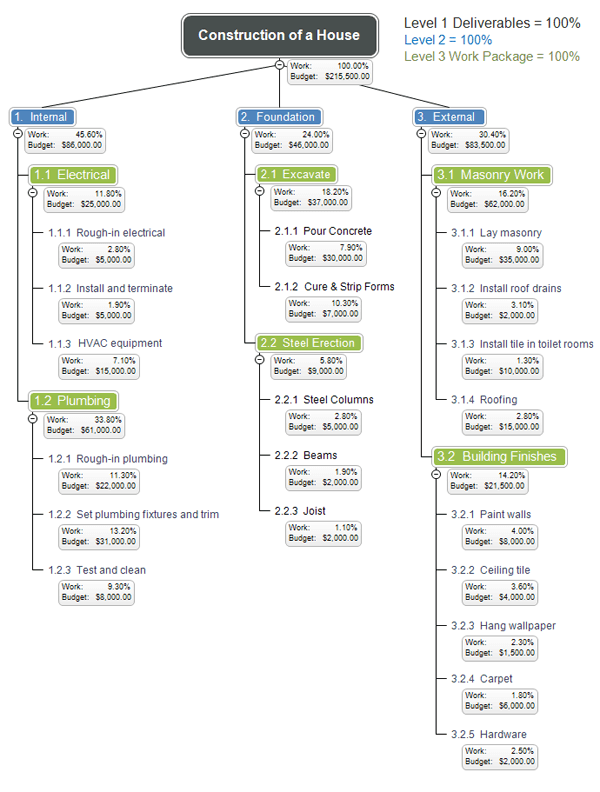
The low-technology approach is easy to do; however, it does not work well with distributed teams or translate easily into an electronic format. There are several tools available that support mind mapping, brainstorming, and work breakdown structures. MatchWare MindView is an easy-to-use mind mapping software package that supports work breakdown structures, project outlines, Gantt charts, and exports easily into Microsoft Project for further schedule definition. Figure 3 provides an example of a work breakdown structure using Matchware MindView.

Mind Mapping software for Work Breakdown Structure
Figure 3. MindView Work Breakdown Structure
Click Here for full size image

The key benefit to MatchWare MindView is its ease-of-use translating work breakdown structures into high level project schedules. A natural extension of the work breakdown structure is the project schedule. By brainstorming the project scope in a mind mapping tool, the project manager can easily assign budget and duration estimates. These budget and duration estimates can easily be exported into Microsoft Excel or Microsoft Project for additional planning and analysis. Project managers want tools that help accelerate their work and reduce the administrative burden that accompanies project management processes.

Work Breakdown Structure Video

Learn how to use MindView to easily create your Work Breakdown Structure / WBS. Apply numbering scheme, completion percentage (100% rule), resources, cost calculation, and more. This video also demonstrates different views as Timelines, Gantt chart, and mind map, as well as several export functions including MS Excel, MS Word, MS Project, etc.


“This Work breakdown structure was made using MatchWare MindView 4”. Click here to build your own work breakdown structure.

https://accounts.google.com/o/oauth2/postmessageRelay?parent=http%3A%2F%2Fwww.workbreakdownstructure.com&jsh=m%3B%2F_%2Fscs%2Fapps-static%2F_%2Fjs%2Fk%3Doz.gapi.id.nfhO6YTP1rM.O%2Fm%3D__features__%2Fam%3DAQ%2Frt%3Dj%2Fd%3D1%2Frs%3DAGLTcCNkfqcYNUlzGS5JuXkJW-qBPG4XOQ#rpctoken=344105267&forcesecure=1

COMMUNICATION  , How to Present to Senior Executives  -HBR, Nancy Duarte

Senior executives are one of the toughest crowds you’ll face as a presenter. They’re incredibly impatient because their schedules are jam-packed — and they have to make lots of high-stakes decisions, often with little time to weigh options. So they won’t sit still for a long presentation with a big reveal at the end. They’ll just interrupt you before you finish your shtick.

It can be frustrating. You probably have a lot to say to them, and this might be your only shot to say it. But if you want them to hear you at allget to what they care about right away so they can make their decisions more efficiently. Having presented to top executives in many fields — from jet engines to search engines — I’ve learned the hard way that if you ramble in front of them, you’ll get a look that says, “Are you kidding me? You really think I have the time to care about that?” So quickly and clearly present information that’s important to them, ask for questions, and then be done. If your spiel is short and insightful, you’ll get their ear again.

Here’s how you can earn their attention and support:

Summarize up front: Say you’re given 30 minutes to present. When creating your intro, pretend your whole slot got cut to 5 minutes. This will force you to lead with all the information your audience really cares about — high-level findings, conclusions, recommendations, a call to action. State those points clearly and succinctly right at the start, and then move on to supporting data, subtleties, and material that’s peripherally relevant.

Set expectations: Let the audience know you’ll spend the first few minutes presenting your summary and the rest of the time on discussion. Even the most impatient executives will be more likely to let you get through your main points uninterrupted if they know they’ll soon get to ask questions.

Create summary slides: When making your slide deck, place a short overview of key points at the front; the rest of your slides should serve as an appendix. Follow the 10% rule: If your appendix is 50 slides, create 5 summary slides, and so on. After you present the summary, let the group drive the conversation, and refer to appendix slides as relevant questions and comments come up. Often, executives will want to go deeper into certain points that will aid in their decision making. If they do, quickly pull up the slides that speak to those points.

Give them what they asked for: If you were invited to give an update about the flooding of your company’s manufacturing plant in Indonesia, do so before covering anything else. This time-pressed group of senior managers invited you to speak because they felt you could supply a missing piece of information. So answer that specific request directly and quickly.

Rehearse: Before presenting, run your talk and your slides by a colleague who will serve as an honest coach. Try to find someone who’s had success getting ideas adopted at the executive level. Ask for pointed feedback: Is your message coming through clearly and quickly? Do your summary slides boil everything down into skimmable key insights? Are you missing anything your audience is likely to expect?

Sounds like a lot of work? It is, but presenting to an executive team is a great honor and can open tremendous doors. If you nail this, people with a lot of influence will become strong advocates for your ideas.

This is the first post in Nancy Duarte’s blog series on creating and delivering presentations, based on tips from her new book, the HBR Guide to Persuasive Presentations.

Apa itu Mind map, caranya bagaimana, mengapa berguna  dan penting , What Are Mind Maps?

Bila ada yg masih blm mengenal, mind map adalah cara mengilustrasikan cara berpikir kita tanpa batas, artinya setiap hub antara satu ide dgn ide lainnya bisa kita tunjukkan, cara ini bisa menunjukkan utk problem definition, case studies, idea problem case breakdown, 

Dan menariknya software ini gratis , google it yourself, 

Anda bisa membantu menterjemahkan semua idea dr team anda dan apa saja yg berhubungan , anda tdk perlu menjadi mahir, keluarkan semua hal , berikan relationship yg berhubungan, anda akan terkejut, betapa hal sederhana ternyata ada byk hal yg terkait, utk executive management andapun bisa tampilkan dlm high level , helicopter view.


Apapun yg ingin anda sampaikan tdk hy dlm mind map, ingat harus ada structure, frame work, sehingga orng lain paham arah tujuan anda.

Legend has it that in the summer of 1994, as the production of Toy Storywas wrapping up, four Pixar creativeswent to lunch to brainstorm ideas for new projects. Sketching on napkins, they teased out ideas for what would become Wall-E; Monsters, Inc.; A Bug’s Life; and Finding Nemo.

It’s inspiring that such massively successful blockbusters started on napkins, but that’s the first step for any good idea, right? Getting ideas out of your head and putting it into the world in some tangible way is how you turn them into reality.

Most people don’t sketch the next great animated movie characters on napkins, but we all need a way to tease out our ideas, think through concepts, and put them into a usable format. That’s essential for creativity, in our personal lives and in business. Lists, outlines, and notes can help, but they don’t always lend themselves to radical innovation, learning, or problem-solving.

There’s a better way: mind maps.

What Are Mind Maps?

Mind Maps

Mind maps can help you capture and stimulate ideas, as well as serve as an important reference

Mind maps are a visual way to organize your thoughts around one topic using words, colors, images and numbers to highlight ideas and draw connections. Invented by Tony Buzanin the 1960s, mind mapping is much more than drawing: It’s a framework to help you fully think through ideas, and show how topics and ideas are connected and allowing with more flexibility than an outline or list affords.

Mind mapping can be a solo or team activity, and they can be used for all types of tasks: learning, thinking through ideas, strategic planning, mapping out processes or organizing overwhelming amounts of information. I’ve even come across mind maps made to plan weddings or organize Thanksgiving dinner.

Roy Grubb, Managing Director atG&A Management Consultants Ltdand creator of the Visual Thinking Center, told me mind maps are of two types: “Maps where the benefit is mainly in the process of making the map, the thinking process, the memory jogging, the stimulation of new ideas and associations; and maps where the benefit is the map as a reference and communication point.”

Why Use Mind Maps Instead of Lists or Outlines?

Mind Map example

Mind maps’ free format encourage fresh ideas

You don’t have to make a mind map—you could just jot a note down on that napkin, or use an outlining app to list the things you’re thinking about. So why mind maps?

“Lists always get long, and they assign importance in terms of where the item is on the list,” explained MeisterLabs co-founder Michael Hollauf. “If something is further down, it’s inherently less important. If you have topics that are on a similar level, it’s hard to show that in a list. Mind maps can reorganize really easily if you decide something belongs to something else.”

In other words, instead of capturing information linearly by default, mind maps can show–and help you discover–connections between different topics, the way your mind works.

List or outlines can be great for small tasks, but Grubb told me fresh ideas are more likely to pop up when creating a mind map because of the free format. “When I’m planning a project, a mind map helps me capture my ideas without having to lay out steps in a linear fashion. I find that a linear list, or even an outline, hems me in and stops me thinking freely.”

How to make a mind map

Mind maps are pretty simple to create, and you can build them on a whiteboard, sketch them on a piece of paper, or use a mind mapping app to create them. These basic steps apply in any medium:

1. Start in the Middle With a Central Idea

Start making a mind map

This can be a word or an image/picture that represents the central topic you’re going to map.

2. Create Branches to Represent Sub-topics

Add branches to your mind map

These should be limited to words or short phrases. Keep a good amount of space between your ideas to leave room to add on later.

3. Add Details to Your Mind Map

Add more detail to your mind map

You can vary colors, word cases, font styles, and even the thickness of your branch lines to separate or group different topics or ideas. Or, you can add photos, notes, and more to add more detail to your map.

4. Make Connections

Make connections and more in your mind map

You can draw lines or arrows between ideas in the map that you want to connect.

Keep expanding for as long as you need to. You might feel done with your map after one sitting, but it could also be something you keep and adjust or add to over time.

Other Mind Mapping Tips

If you’re a beginner

For mind mapping beginners, it can be helpful to have a pro guide your first few maps.

“Look for someone who often uses mind maps and ask their opinion,” Grubb told me. “This can help to remove blocks to mastering the technique in the early days.”

If you’re not artistically inclined

Don’t worry if you’re not an artist; that’s not the point of a mind map.

“One of the things we hear often is ‘I can’t draw,’” says Raphaela Brandner, marketing manager at MeisterLabs, creators of mind-mapping tool MindMeister. “It’s not about making it beautiful, it’s about making it memorable.”

You don’t need to make a masterpiece: “They’re thinking tools, not works of art,” Grubb says.

If you’re mapping with your team

When mapping with others, it helps to set some ground rules first. “What we do here is we come to some fort of agreement for how the map is going to be used,” Brandner says. “We say we’ll ‘add comments here’ or ‘use these icons for this.’”

With technical teams, Grubb opts for mind mapping software on a laptop with the map projected onto a screen. For teams who are new to mind maps, he maps on large sheets of paper or a whiteboard.

“It helps to be in front of the map, talking as I add to it while the ideas bounce back and forth,” he says. “I can explain what I’m doing as we go along, and at the end, capture images of the maps on a phone before erasing them.”

As the meeting progresses, Grubb gets people more involved: “I look for opportunities to hand over the marker so that everyone has ownership of the mind map.”

If you’re working remotely

Mind mapping tools make it easy for distributed teams make maps together.

“When working with others who may be in distant offices, online mind mapping services, like MindMeisteror Mindmup, are indispensable,” Grubb says. “Several people can work on a map simultaneously and they can chat online or in the app. Both MindMeister and Mindmup have project planning capabilities, allowing dates and resources to be added to individual items.”

Other mind mapping tools includeMindjetCoggleXMindFreeMindand MindNode.

When to Use Mind Maps

Mind maps are often used in schools, so people tend to associate them mainly with learning and studying. But there are a ton of business applications for mind maps, too.

“Many students are shown how to make mind maps to help with learning but never take the skill on into their business careers,” Grubb says. “Those that do find they have a tool that is good for much more than just understanding school work.”

Grubb told me he sees businesses using mind maps for ideation, product design, website design, project planning, management, report writing, and planning software testing.

Here are just a few business-focused tasks mind maps can help with:

When Absorbing What You Read

Mind Map example

Reading is an important way to grow as a professional, but with busy schedules, it can be hard to digest a book or resource enough to apply it to your work.

Mind maps can help you truly absorb what you read. For example, Grubb used a MindMap to summarize the book Made to Stick by Chip and Dan Heath. First, he read the book and highlighted words and phrases that caught his attention. When he was done reading, he went back and made a mind map from the highlighted sections and was able to use that mind map to successfully guide his next project.

Mind maps for presentations

Students turn to mind maps—especially hand-written maps—when studying because they help with memorization.

“That tactile experience works a lot better for memorizing,” Brandner says. “That’s what I did in school. Once you have mind map and you’re about to go into the exam, you redraw the mind map by hand to get it into your brain.”

You could use a similar process to prepare for a speech or presentation. You’ll feel more confident about the content and might not have to rely on notes as much during the presentation.

When Managing a Project

Mind Maps for projects

Some project managers use mind maps to take notes in meetings. Instead of pages of linear notes, you can put the meeting topic in the middle and create branches for each major sub-topic discussed.

“When I do this, it’s amazing to me how I see things differently,” writes business analyst and marketer Tim Walker. “I pay more attention during the meeting, and I leave with a much better idea of what I could do next to move the work forward.”

Making mind maps can also help prioritize project tasks.

“When you map things radially, you take away the rank order and chronology that’s inherent in an outline or Gantt chart,” Walker writes. “Instead of prematurely worrying about which part of your project comes first in sequence, or which part deserves the most resources, you can focus on getting the right issues surfaced in a way that promotes dialogue, understanding, and problem-solving”

When Trying to Generate New Ideas

Mind maps for ideas

Use mind maps to combat writer’s’ block, think up new product ideas, or generate possible solutions to a problem you’re facing.

“Generating a starting point for innovation can be one of the most productive uses of mapping,” Grubb writes. “Ideas can tumble out of control. Writing them in a list easily kills the inspiration, but organizing them in a mind map not only gives the freedom to wander ‘all over the map,’ but encourages grouping, thus often bringing ideas together that give birth to new thoughts.”

Automate Your Mind Maps

Your mind maps can be put to even more use if you connect your content in them with your favorite apps. With Zapier, an app automation tool, you can send tasks or topics from MindManager Enterprise to many other apps, such as Google Docs, Trello, Asana, and Evernote.

For example:

Send MindManager content to Google Docs

Use this Zap

Send MindManager tasks to Trello

Use this Zap

Send MindManager topics to Box

Use this Zap

Send MindManager tasks to Asana

Use this Zap

Send MindManager content to Evernote

Use this Zap

See more MindManager Enterprise integrations powered byZapier

See other MindManager Enterprise app integrations or create your own.


Who knows, maybe you are planning to pitch an idea to Pixar for Hollywood’s next loveable robot, clown fish, or furry monster. If so, ditch the napkins, and try a mind map.

And the next time you want to make sense of information, successfully plan a big project, run a meeting, learn something new, streamline the way you work or even plan Thanksgiving, mind maps can work for you, too.

Source zapier

​Sekilas Program Management

Term project management sering salah kaprah, sering kita melihat postingan job vacancy : project manager operational,
Project jelas adanya start dan finish, project boundary harus ada agar project itu jelas apakah achieve dgn deliverable scope cost time quality, comply dgn requirement.
Project itu uniqe dan temporary bukan operational  dgn performing team yg relative sama, repeated activities.
Lalu apa program management,
Aplikasi dr skill,tools,teknik,  knowledge, ke aktifitas di project2 agar sesuai dengan requirement dari program itu sendiri.
Ingat requirement di IT ada 3:

Align dgn Bussines procesess,

Functional dan non funct ( availability, reliability,security dll)
Apa bedanya dgn project management ?
Project mgmt focus ke scope time cost dll
Program mgmt harus bisa manage ke project2 yg dideliverynya. Mengatur para project manager.
Focus ke alignment dgn company strategic, resources constrain, resolve commont problems.

Yg paling penting adalah ROI , bagaimana yg kita investasikan bisa sesuai yg kita planning dan target kan.
Program membawahi project2 yg identik dan transition ke operation.

Operation di sini ada lead2 yg accountabilitynya berbeda dgn team project , focus ke SLA OLA CSF dan kpi.
Artinya apa :
Seorang program management harus paham benar product portfolio , karena turunan dr portfolio adalah program mgmt.
Harus tahu product value product life cycle end to end, dari scratch ide sampai ke market : baca revenue.
TITIK awal dr program adalah value, bisnis.
Berikut program management:
Pre program : ini adalah business case, apakah worth it tidak ini utk bisnis.
Program set up: executing strategy, framework
Program management
Program delivery
Closing dan transition
Lalu 
Operational.

Sebuah product yg berhasil , akan selalu berkesan ke hati pelanggan dan kantong revenue perusahaan.

Price perception content.
Yamaha xs 650 1970 

​Risk dalam project management

Risk kerap dilewatkan atau hanya sebagai formalitas,
Sejatinya bila benar benar dilakukan dan diantisipasi , hasilnya akan sangat berguna terutama saat saat ini dimana target pertumbuhan byk negara  yang direvisi.
Ada beberapa standard utk risk ada IRM 2002 dr UK , ada iso kepala 31000 dll.
Garis merahnya hampir sama,

Yg sy akan bahas dibawah adalah risk management dr pmbok 2012 fith edition, gak beda jauh bila anda compare dgn iso 21500.
Risk persepsi  banyak ditangkap adalah negative,apalagi bila diterjemahkan dgn bahasa indonesia resiko, udah kartu mati.
Risk bisa positive atau negative.
Ada beberapa attitude , company terhadap risk,
1. Appetite , ini adalah willingness gairah keinginan perusahaan dlm menghadapi resiko. Tentu tidak membabi buta.ada  batasannya.
2. Tolerance.

Resiko yg bisa ditoleransi, misal kita beli equipment dgn usd tp jual dgn rupiah. Berapa deviasi tolerance nya , utk dpt margin , ditambah interest, cost equity , tempo waktu kita dibayar setelah done, 90 hari , atau kalau ingat setelah ditagih tagih . wkk  
3.threshold 
Lebih ke nilai quantitative, ini penting , anda harus set nilai nya secara jeli dan disiplin, ingat juga risk management bersifat iterative artinya tdk hanya didepan project, tapi diseluruh project life cycle. Gunakan earned value management utk performance control.

Kemudian apa delivery yg harus dilakukan dlm risk management.
1. Risk management plan

2. Risk list identification

3. Risk list quantitative

4. Risk list qualitative

5. Risk list respond planning

6. Risk list control.
quantitative adalah ukuran dlm matematika misal papan tulis, ukuran panjang x lebar, berat dlm kg berapa.
Sementara qualitative lebih bersifat kualitas, misal perception, satisfaction, scope juga bisa dimasukkan.
Biasanya saya buat risk list sbb:
1. Risk list identification.

Ingat risk ada luas, political, economic, social, technic , dll.
2. Risk list description.

3. Sign atau symtom atau tanda2 nya apa.

4.ada di project management knowledge mana : int scope time dll

5. Ada di project life cycle mana: starting , prep, exe, closing ?

6.impact nya : high medium low, bisa juga kita gambarkan dlm angka.

7.probabilitynya, high medium low, bisa juga dlm percentage

8.occurence, jarang, sering ?

9. Impact bila negative: avoid, transfer, mitigate , accept ?
10. Impact bila positive, exploid, enhance ?
11.respond planning nya apa?
12.ownership nya siapa.

13. Risk id, 

14. Risk date.

15. Remark/ description

16. Risk category : strategic,operational, finance, compliance.
Banyak kan.

Dari list tersebut bisa kita petakan ke dalam grafic,
Ingat bila kita orang technic, focuskan juga ke arah business, persepsi management lbh kearah value dari business itu , objective  dari project tersebut.
Walau seakan menguntungkan tp kemampuan terbatas dan membahayakan operational business lbh baik dicermati secara seksama.
Apalagi bila product portfolio yg kita jual belum mature,

Ingatkan bcg matrix: market vs growth.

Itsm value ?

Product life cycle ?