Communication


Communication

  • Communication has been identified as one of the single biggest reasons for project success or failure.
  • Effective communication within the project team and between the project manager, team members, and all external stakeholders is essential.
  • Openness in communication is a gateway to teamwork and high performance.
  • It improves relationships among project team members and creates mutual trust.
  • To communicate effectively, the project manager should be aware of the communication styles of other parties, cultural issues, relationships, personalities, and overall context of the situation.
  • Awareness of these factors leads to mutual understanding and thus to effective communication.
  • Project managers should identify various communication channels, understand what information they need to provide, what information they need to receive, and which interpersonal skills will help them communicate effectively with various project stakeholders. Carrying out team-building activities to determine team member communications styles (e.g.directive, collaborative, logical, explorer, etc), allows managers to plan their communications with appropriate sensitivity to relationships and cultural differences.
  • Listening is an important part of  communication.
  • Listening techniques, both active and effective give the user insight to problem areas, negotiation and conflict management strategies, decision making, and problem resolution

The communication activities involved in these processes may often have many potential dimensions that need to be considered, including, but not limited to:

• Internal (within the project) and external (customer, vendors, other projects, organizations, the public);
• Formal (reports, minutes, briefings) and informal (emails, memos, ad-hoc discussions);
• Vertical (up and down the organization) and horizontal (with peers);
• Official (newsletters, annual report) and unofficial (off the record communications); and
• Written and oral, and verbal (voice inflections) and nonverbal (body language).

Most communication skills are common for both general management and project management, such as, but not limited to:

• Listening actively and effectively;
• Questioning and probing ideas and situations to ensure better understanding;
• Educating to increase team’s knowledge so that they can be more effective;
• Fact-finding to identify or confirm information;
• Setting and managing expectations;
• Persuading a person, a team, or an organization to perform an action;
• Motivating to provide encouragement or reassurance;
• Coaching to improve performance and achieve desired results;
• Negotiating to achieve mutually acceptable agreements between parties;
• Resolving conflict to prevent disruptive impacts; and
• Summarizing, recapping, and identifying the next steps.

Successfully performing the project requires the following:

  • ✓ Information: Accurate, timely, and complete data for the planning, performance monitoring, and final assessment of the project
  • ✓ Communication: Clear, open, and timely sharing of information with appropriate individuals and groups throughout the project’s duration
  • ✓ Commitment: Team members’ personal promises to produce the agreed-upon results on time and within budget

Key Communication Principles Principle :

  • Accountable communication inspires positive action in others.   Long after people forget what you said, they remember how you made them feel.
  • Provide positive direction , You: “The reason I wanted to meet is to make sure we are both heading in the same direction.”
  • State your concern, You: “Your recent report raised some questions for me. I’d like to go over several specific points.”
  • Take accountability ,You: “That’s my intention. I want to make sure I’m clear about what is needed from you.”

Your Communication Is Accountable When:

  • People are inspired. They go into action to make things happen.
  • People re-create your message for others. They use their own words to restate what you want and when you want it.
  • People know what is important. They are clear about your priorities and what needs to happen first.
  • People are emotionally and intellectually engaged. Your message has tapped both their hearts and minds

Inspires positive action in others

  • “That’s the problem in a nutshell.” add, Now it’s up to us to turn this around.”

  • “This is an issue we must address quickly.” Add: “I’m confident we can do this.”

  • “We will meet on Friday at 8 a.m. in the conference room.” Add: “Let’s use this time to generate new ideas together.”

  • • “I haven’t had a chance to read your report.” Add: “I always appreciate how you look at things.”

  • • “We are facing a number of challenges this next year.” Add: “I’m happy to be on a great team.

  • We’ll need everyone’s thinking and energy.” • “Good morning. ” Add: “It’s always good to see you.”

  • • “Here’s the document. Read it and let’s talk.” Add: “I’m interested in hearing your thoughts.”
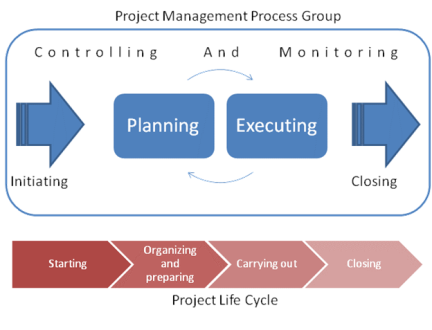
Project life cycle

Project life cycle

image


Project life cycle

A project life cycle is the series of phases that a project passes through from its initiation to its closure.

It should not be confused with the Project Management Process Groups, because the processes in a Process Group consist of activities that may be performed and recur within each phase of a project as well as for the project as a whole. The project life cycle is independent from the life cycle of the product produced by or modified by the project

Project life cycle structure:

  • Starting the project,
    • How to obtaining authorization to begin project.
  • Organizing and preparing,
    • Developing comprehensive of  project planning
  • Carrying out the project work,
    • Executing activities based on project planning
  • Closing the project.
    • Finalizing all activities of project

Successfully performing these processes requires the following:

✓ Information: Accurate, timely, and complete data for the planning, performance monitoring, and final assessment of the project
✓ Communication: Clear, open, and timely sharing of information with appropriate individuals and groups throughout the project’s duration
✓ Commitment: Team members’ personal promises to produce the agreed-upon results on time and within budget


Problems related to project requirements


image

Project’s Requirements

The most difficult part of a new project is often deciding where to begin. Expectations are high, while time,cost,resources are limited but the requirements most often “float”.
one of  the critical thing about to begin projects is requirements, how to  identify requirement while some people mention is heart of project itself,
Unclearly requirements, not detailed requirements,inadequate initial requirments,  will be a huge time bomb for these project ,
Problems related to project requirements:
  • Features are missing
  • Unnecessary features have been included
  • Features that work differently than expected
  • Necessary features that nobody thought about
  • Dispute to the conclusion of a project,
    • Disputes between customer and Project team regarding the interpretation and the provision of all required features.
    • Attempts to include last minute changes
A project manager should avoid committing to either development schedule or budget before the project has been adequately defined. In most cases, a firm commitment can be given only after the requirements are concluded.
      • If the requirements of a project are not met, then adhering to the budget and schedule becomes meaningless.
      • A customer or user will not always provide the correct requirements. It is often the project team’s responsibility to ask the right questions in order to collect the necessary information.


8 Tips for Managing Project Costs

1.  Produce an estimate. Compile a realistic estimate with your team. Make sure it covers all the project’s phases and activities and that it contains sufficient contingency. Account for all people costs as well as materials, hardware and software

2. Achieve a baseline budget. Formally get the estimate signed off by the sponsor and steering committee and ensure that the actual funds get released and allocated to the project. You now have a baseline budget to work from.

3. Establish monthly budget. Determine what you expect the project’s monthly running costs to be based on your knowledge of the project’s resource plan and schedule. Document the monthly expected expenditure in a spreadsheet encompassing the entire project.

4. Establish cost controls. Set up clear cost controls and sign-off responsibilities for the different types of expenditure. Consider who will be approving and signing off on timesheets, materials, hardware, software and vendor invoices. This part is crucial as this is where you control the actual costs that will be booked to your project.

5. Record actual costs. Check the actual amount of money accounted to your project at the end of each month. This figure will normally be provided to you by the finance department.  Record this amount in your spreadsheet so that you can directly compare it to your budget.

6. Calculate metrics. Calculate and update your cost metrics at the end of each reporting period. Measure how much money the project has spent of the total budget compared to how much money you had expected it to spend at this point in time. Include your cost metrics into your project reports and steering committee presentations.

7. Update forecasts. Adjust your forecasts on a monthly basis to cater for any changes that have taken place. Changes could stem from the actual running costs being higher (or lower) than forecast or estimates being
higher (or lower) than forecast. 

8. Communicate. Create transparency to senior management around the project’s costs by including your cost metrics and key numbers into your project reports and steering committee presentations. If for some reason your costs are not on track, treat it as an urgent issue which must be analysed, resolved and discussed with the steering committee.

Cara Mudah Perencanaan Project


Membuat perencanaan project, tidak harus menjadi project manager,Semua bisa mudah dan untuk semua, mulai dari apa yg sekarang anda kerjakan , kemudian melangkah menuju impian.


Simple Gantt Chart.PNG

download filenya: Project Schedule (gant chart)

  1. tentukan jelas  tujuan Project:
  2. Scope dari project anda, deliverable nya apa ?
  3. Stakehoder anda, manage needs, concern, expectation dr pemberi project
  4. Apa saja yg yg dibutuhkan utk anda mencapai tujuan project: resource ?
  5. paham baseline project: scope, cost, time completion
  6. Quality bukan basa basi
  7. buat daftar aktifitas, defining, urutan aktivitas, PIC, duration, lalu buatlah Schedule project, control : plan VS actual.
  8. rutin Monitoring & komunikasi dgn team & customer anda.